

Mastering the Data Lake
June 12, 2018 | Authors: Kaizen
With the data explosion across every industry, storing all of your enterprise’s Big Data in a Data Lake is the right answer. Data Lakes easily provide both linear and modular scalability. Moreover, they unlock the value of unstructured data while significantly reducing overall infrastructure costs.
To ensure a smooth, swift, and successful deployment of your Data Lake – and to maximize delivery of business value from it – IT, Sales, Marketing, Finance, Supply Chain, and other business leaders should ensure that their teams are aware of the fundamental differences between traditional data approaches today and leveraging data through the Data Lake tomorrow.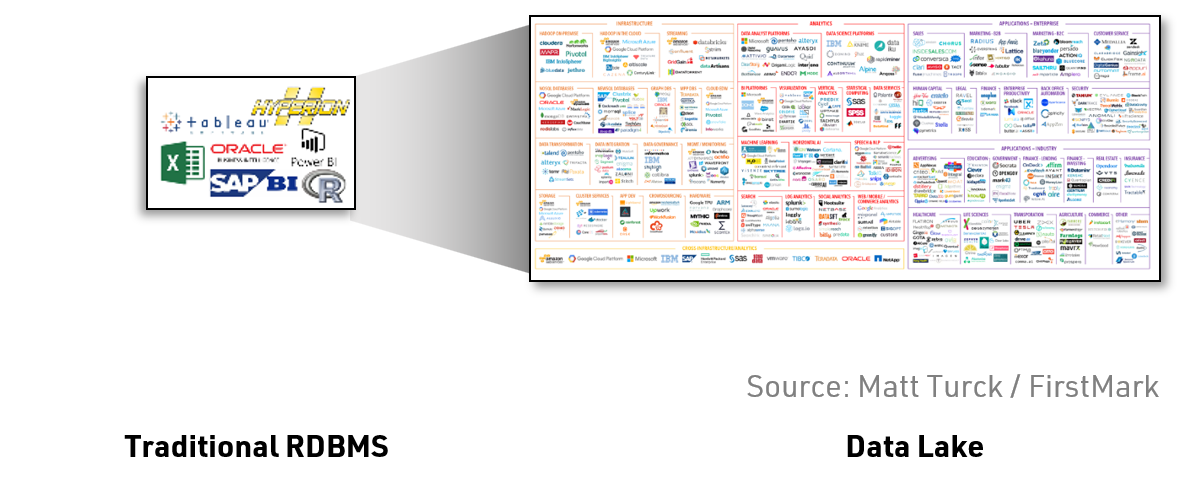
Navigating the Shift from Traditional Relational Database Management (RDBMS) to a Data Lake
From our experience, we have assembled the information below with the goal of empowering leaders in Information Technology and their Sales, Marketing, Finance, Supply Chain, and other business partners with perspectives on the paradigm shift driven by a Data Lake.
Dimension: Query Execution
Traditional RDBMS:
Query execution for properly indexed tables are tuned to a certain extent by the RDBMS for better performance with the following limitations:
Data Lake:
Data is stored as files in a distributed file system called HDFS. Since queries are executed on each HDFS node, query execution is slower than RDBMS on the HDFS systems.
Kaizen Viewpoint:
Data Lakes will need additional tools on top of traditional Hadoop / Yarn HDFS to ensure ease of querying. For column-based data structures, systems like HBase or Impala add the ability to query Data Lakes and respond in real time.
Dimension: Caching
Traditional RDBMS:
Traditional RDBMS systems come with several levels of in-memory / fast access stores for caching:
Data Lake:
Queries get queued onto the HDFS in a system like Hive. By design, indexing does not exist in HDFS. Caching can be configured; however, cache invalidation criterion can cause full table scans each time a query is executed.
With this, when some active users are executing queries, queries from others get queued.
As a result, execution timings may be high to a point they impact resource productivity.
Kaizen Viewpoint:
Tools like Apache Spark provide the caching with speed. Spark enables in¬-memory datasets (RDDs) as a first-class construct. Multiple stages of reads and writes can happen purely in-memory without accessing disk. By storing lineage information about data transformations, they provide fault¬ tolerance even for in-memory datasets through re-computation.
Dimension: Transactionality (ACID) & CRUD Data Operations
Traditional RDBMS:
RDBMS Systems are built on transactionality concepts where each transaction is
In Create, Read, Update, and Delete (CRUD) operations performed on data, create, update and delete are transactional operations.
In traditional RDBMS systems, these operations are basic concepts and are done at row level.
Data Lake:
Data updates are possible only on some row/columnar file formats like RC (Row Columnar), ORC (Optimized Row Columnar), Parquet etc.
Kaizen Viewpoint:
Data lake implementers should be aware of the requirement of the underlying table.
Choosing the optimal file format in Hadoop is one of the most essential drivers of functionality and performance for Big Data processing and query in a Data Lake.
Dimension: Application Programming & Business Analytics Implementations
Traditional RDBMS:
Capabilities inherent in RDBMS approaches allow for a degree of flexibility in Application programming and Analytics tools
Data Lake:
Application programmers must match coding style to Big Data distributed environment. This requires understanding of responsibilities of Data Layer and Programming Layer.
While RDBMS can be forgiving, Big Data environments have revived the importance of data driven design. A few key areas to focus on are:
Kaizen Viewpoint:
Analytics and Operations Research teams should have or be supported by strong technical expertise in Data Lake implementations to ensure a smooth and successful delivery of your Data Lake.
Dimension: Performance Testing
Traditional RDBMS:
During implementation, a Performance Improvements phase can run in parallel with Functional phases.
Data Lake:
Projects typically require a Performance Tuning phase. Big Data applications often require additional focus on performance testing
Kaizen Viewpoint:
Performance rework can be minimized with the “right” upfront Data Lake design and with an understanding of implications from design choices.
Dimension: Integration into Tools through APIs
Traditional RDBMS:
Nearly all analytics tools provide integration into all RDBMS systems.
Data Lake:
Integration is evolving and not fully “there” yet
Kaizen Viewpoint: Given the multitude of Big Data tools, knowing the right tool to use and how to integrate it will be crucial for ensuring a smooth and successful delivery of your Data Lake.
Dimension: Expertise / Skill Availability
Traditional RDBMS:
Large pools of resources are available to support initiatives.
Data Lake:
Large pools of resources who claim to have required skill sets are available, but typically these resources come with RDBMS baggage.
Kaizen Viewpoint:
Having resources with the right skill sets is the #1 key for Big Data success.
Kaizen Analytix: Masters of the Big Data Lake
Kaizen Analytix has a wealth of experience helping companies quickly generate insights from their own and industry data sources, with a technology-agnostic perspective.
This experience brings our company into direct contact with Big Data and Data Lakes, and we are now considered authoritative sources on this subject.
In working with clients on Data Lake projects, we have successfully…